

Information
For visitors
Geography

The Kingdom of Cambodia, formerly Kampuchea, is a country in Southeast Asia bordered by Thailand, Laos, Vietnam, and the Gulf of Thailand. Its capital is Phnom Penh.
Located in the southwest of the Indochinese Peninsula, Cambodia occupies a total area of 181,035 square kilometers and is bordered by Thailand
to the west and northwest, Laos to the northeast, Vietnam to the east, and the Gulf of Thailand to the southwest. Cambodia's geographic coordinates are 13° 00 N, 105° 00 E. Cambodia's terrain consists mainly of low-lying plains, with mountains to the southwest and north. Cambodia's two dominant physical features are the Mekong River, which flows from the north to the south of the country, and Tonlé Sap Lake. Natural resources include oil and gas, timber, gemstones, iron ore, manganese, phosphates, and hydroelectric potential.
Religion

Theravada Buddhism is the dominant official religion in Cambodia, and approximately 90% of the population is Buddhist. Islam, Hinduism, and Christianity are also practiced in Cambodia.
As Buddha statues and images depict the revered Buddha, visitors are asked to treat them with respect so as not to offend the local population.
In Cambodia, regardless of religion, the country maintains a harmonious state.
Public holidays
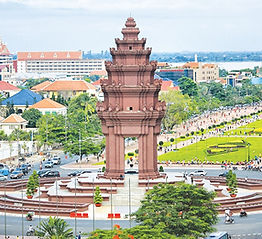
The Kingdom of Cambodia is full of traditional and cultural festivals, celebrated according to the Cambodian lunar calendar. All are influenced by concepts from Buddhism, Hinduism, and royal cultures. Most of them are major celebrations for both urban and rural populations, celebrated annually as follows:
International New Year’s Day
On the eve of International New Year, the Ministry of Tourism organizes the Countdown Day celebration in front of NagaWorld Hotel in Phnom Penh. Representatives from both public and private sectors participate in this festival to welcome the new year.
Monday, January 1, 2024
Victory over the Genocidal Regime Day
Victory Day commemorates the fall of the genocidal Pol Pot regime. This important national event is marked by a military parade, carnival floats, and various public celebrations. Throughout the city, flags and banners—symbols of national pride—decorate shops and homes along the main roads.
Sunday, January 7, 2024
International Women’s Day
International Women’s Day is a global celebration honoring the economic, political, and social achievements of women. It is also a day to show respect, appreciation, and love for women everywhere.
Friday, March 8, 2024
Khmer New Year
Khmer New Year, known as "Bon Chol Chhnam Thmei Khmer" in Khmer, is celebrated on April 13 according to the traditional Cambodian lunar calendar. The holiday lasts for three days and marks the end of the harvest season — a time when Cambodian farmers enjoy the fruits of their labor before the rainy season begins.
Sunday, April 21, 2025
Monday, April 22, 2025
Tuesday, April 23, 2025
Visak Bochea Day (Buddha’s Birth and Enlightenment Day)
Visak Bochea Day, or "Bon Visakh Bochea" in Khmer, commemorates the birth and enlightenment of the Buddha.
Wednesday, May 22, 2025
Royal Ploughing Ceremony
Known as "Bon Chroat Preah Nongkoal" in Khmer, the Royal Ploughing Ceremony marks the beginning of the sowing and planting season. This important cultural ritual takes place annually in May at Meru Field, in front of the National Museum, next to the Royal Palace.
Sunday, May 26, 2025
International Labour Day
International Labour Day celebrates the economic and social achievements of workers. It has its origins in the labor movement, particularly in the campaign for an eight-hour workday — eight hours of work, eight hours of leisure, and eight hours of rest.
Wednesday, May 1, 2025
Royal Birthday of His Majesty King Norodom Sihamoni
A solemn celebration held at the Royal Palace, with fireworks over the Tonlé Sap on May 14, honoring King Norodom Sihamoni, son of the late King Norodom Sihanouk. His Majesty was born on May 14, 1953, in Phnom Penh.
Tuesday, May 14, 2025
Royal Birthday of Her Majesty Queen Mother Norodom Monineath Sihanouk
A day honoring Her Majesty the Queen Mother of Cambodia, celebrating a life of dignity, freedom, and joy.
Tuesday, June 18, 2025
Constitution Day
Constitution Day marks the promulgation of the Constitution of the Kingdom of Cambodia, which was adopted on September 24, 1993.
Tuesday, September 24, 2025
Pchum Ben Day (Ancestors’ Day)
Pchum Ben, or "Bon Phchum Ben" in Khmer, is one of Cambodia’s most significant religious and cultural festivals. Celebrated over 15 days, the final three are public holidays dedicated to honoring the spirits of the deceased, including ancestors and lost loved ones.
Tuesday, October 1, 2025
Wednesday, October 2, 2025
Thursday, October 3, 2025
Flag

The flag of Cambodia symbolizes the country's motto: Nation, Religion, King. The two large blue stripes represent royalty, while the central red stripe represents the nation. The image of the white temple represents the country's religion.
History

The race that gave rise to the builders of Angkor slowly developed through the fusion of the Mon-Khmer ethnic groups of southern Indochina during the first six centuries of the Christian era. Under Indian influence, two main centers of civilization developed. The older, in the far south of the peninsula, was called "Funan" (the name is a Chinese transliteration of the ancient Khmer form of the word "Phnom," meaning "hill"). Funan was a powerful maritime empire that ruled all the shores of the Gulf of Siam. In the mid-6th century, the Kambuja, who lived in the middle of the Mekong River (north of present-day Cambodia), broke away from Funan. In a short time, this new power, known as Chenla, absorbed the kingdom of Funan.
At the end of the 7th century, Chenla split into two parts: Land Chenla (in the north) and Water Chenla (in the south, along the Gulf of Thailand), dominated by the Chinese. Land Chenla enjoyed relative stability in the 8th century, while Water Chenla was plagued by dynastic rivalries. During this period, Java invaded and took control of part of the country.
Food


Cambodian cuisine includes noodles, soups, grilled dishes, stir-fries, curries, salads, desserts, a large number of vegetables, tropical fruits, and, of course, rice, the Cambodian staple. Cambodian culinary secrets are rarely written down; instead, recipes are passed down from mother to daughter. From ancestral origins, a traditional cuisine has been born, full of unexpected treasures: a unique blend of flavors and colors that enhances the natural ingredients used.
Cambodians have perfected the art of blending spice pastes from a variety of ingredients, including cloves, cinnamon, star anise, nutmeg, cardamom, ginger, and turmeric. They add other local ingredients, such as galangal, garlic, shallots, lemongrass, coriander, and kaffir lime leaves, to create a unique and complex spice blend called "kroeung."
Although noodles are also popular, almost every meal includes a bowl of rice. A wide variety of curries, soups, and stir-fries are commonly served with rice. In a country that produces many varieties of rice, tourists can sample the finest aromatic grains and different types of sticky rice. The latter is most often served with salad or in fruit desserts.
Two other unique ingredients give Cambodian cuisine its fabulous, distinctive flavor: pra-hok, a spicy fermented fish paste, and kapi, a fermented shrimp paste. These ingredients take some getting used to, but are appreciated by some, who use them in many dishes or even as a sauce. Together, these ingredients have become an important flavor combination commonly used in Cambodian cuisine.
A Cambodian meal is typically served with rice and at least three other dishes. It usually includes soup (samlor), served as an accompaniment to the main courses. Each of these dishes can be sweet, sour, salty, or bitter; they coexist harmoniously, sometimes even within the same dish, to create a unique melody. Chili pepper is usually added to the menu, ensuring that tourists are sure to find a little of each flavor to satisfy their palate.
Recommendations for travelers
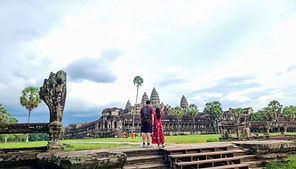
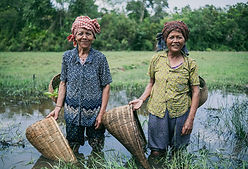
Dos and Don'ts in Cambodia
Cambodians are renowned for their hospitality and warmth. Out of respect, visitors to the Kingdom are encouraged to observe local customs and practices. It may be helpful to familiarize yourself with the following dos and don'ts before traveling to Cambodia.
Things to do in Cambodia
-
Ask permission before photographing Cambodians or monks.
-
It is customary to remove shoes when entering a place of worship such as a pagoda or temple. Additionally, visitors must dress appropriately inside a religious site (arms and legs covered, hat removed).
-
It is respectful to take off your shoes when entering someone's home.
-
Although not always expected, a respectful way to greet someone is to bow your head slightly with your hands clasped across your chest (called "Sampeah").
-
If you are invited to dinner at a Cambodian family's home, it is polite to bring a small gift for the host, such as fruit, dessert, or flowers.
-
If you are invited to attend a Cambodian wedding, it is customary to bring cash as a wedding gift.
-
When using a toothpick at the table, cover your mouth with one hand.
-
Have your business cards ready and present them with both hands. Accept business cards with both hands.
DON'Ts in Cambodia
-
Don't use your feet to point at someone.
-
Don't touch a Cambodian's head.
-
Don't start eating if you are invited to a dinner party and the host hasn't taken a bite yet.
-
Women should never touch monks or offer them anything directly.
-
Limit public displays of affection to a minimum.
Common Sense Practices
-
Don't litter; keep our community clean and safe.
-
Plastic bags can be dangerous; dispose of them properly.